
If your garage door rolls crooked, grinds partway up, or has gaps between the rollers and the track, the tracks are bent or misaligned. The fix depends on how bad the damage is: loose brackets just need to be tightened and the track reset, a mild bend can often be pried back into shape, but a creased or kinked rail has to be replaced. Here's how to tell what you're dealing with before anyone touches a wrench.
Symptoms to Watch For
Track problems rarely show up as one obvious failure. They tend to show up as a handful of small, annoying signs that get worse over a few weeks:
- The door moves unevenly, with one side higher or lower than the other as it travels
- You hear grinding, scraping, or a rhythmic clunk as the rollers pass a certain spot
- The door hesitates, jumps, or slows down at the same point every time
- You can see daylight or a visible gap between a roller and the track rail
- The door has partially jumped the track, hanging at an angle instead of sitting flush
- Rust, dents, or a visible kink in the metal rail itself
Any one of these on its own might not mean much, but two or three together almost always point to a track issue rather than a spring or opener problem.
What Causes It (In the Order a Technician Checks)
1. Loose or Shifted Brackets
This is the first thing a technician checks, because it's the most common cause and the easiest to fix. The vertical and horizontal tracks are bolted to the door frame and ceiling with brackets, and those lag bolts work loose over time from the vibration of daily opening and closing. In this area, freeze-thaw cycles in the garage framing can loosen fasteners even further over a winter. Loose brackets let the whole track rail flex slightly out of position every time the door runs, which eventually bends it. The fix is straightforward: retighten every bolt along the run, and if the wood behind a bracket has worn out or split, the bracket gets relocated to solid framing.
2. Impact Damage
Next, a technician looks for a direct hit: a car bumper backing in too far, a bike or ladder leaned against the rail, a snow blower or shovel catching the bottom section in winter. Impacts usually show up as a localized dent or outward bow in one spot rather than a gradual drift. A mild bend, where the metal is bowed but not creased, can sometimes be straightened in place with locking pliers and a rubber mallet while the rail is still mounted. A sharp crease or kink, where the metal has actually folded, won't hold alignment once it's bent back — that section of track needs to be unbolted and replaced.
3. Worn or Broken Rollers
If the brackets are tight and there's no visible impact mark, the next suspect is the rollers themselves. Old steel or dried-out nylon rollers develop flat spots or seize up in their bearings, so instead of rolling smoothly they drag and push sideways against the track wall. Over months, that constant outward pressure bends the rail even without any single impact. The fix is simple roller replacement, usually with sealed-bearing nylon rollers, which run quieter and put far less stress on the track going forward.
4. Structural Shift in the Frame
Houses in this part of Illinois deal with real seasonal movement — humid summers swell wood framing, dry cold winters shrink it, and that cycle repeats every year. Over time it can shift a door jamb or header just enough to throw off track alignment even when the track itself is undamaged. A technician checks this by measuring the gap between the track and the door panel at several points; if it's tapering in one direction, the frame has moved rather than the track. The fix here is remounting the brackets at new anchor points, sometimes with shims to correct the angle, rather than swapping metal.
5. Spring Imbalance Pulling the Door Off-Center
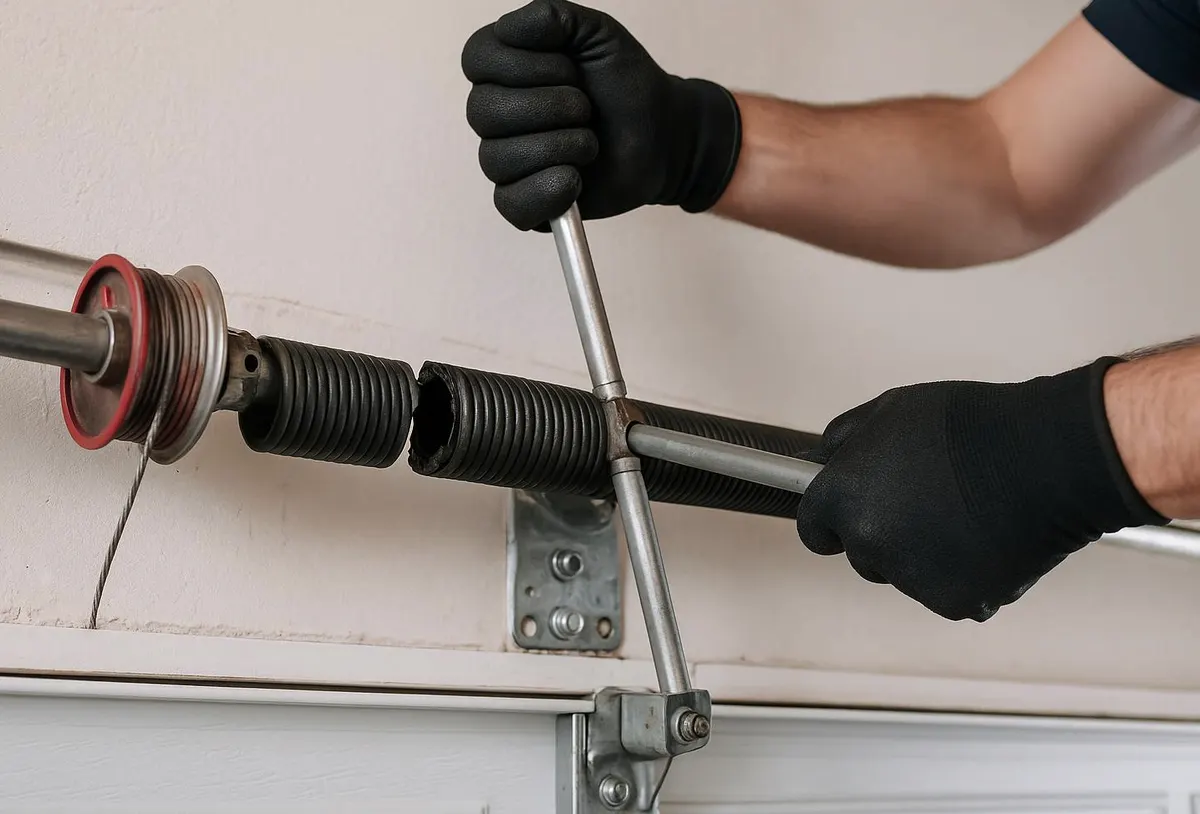
Last on the checklist, because it's less obvious: a broken or unevenly wound torsion spring makes one side of the door lift before the other, so the door travels at a slight angle every single cycle. That constant off-square motion stresses the rollers and the track over time, even if the track was fine to begin with. Correcting spring tension fixes the root cause, and the track is realigned afterward so the door travels true again.
When to Call Orland Park Garage Door
If your door has jumped the track, is grinding on one side, or you can see a visible bend in the rail, stop running the opener — continuing to force a misaligned door usually turns a track repair into a track-and-roller-and-panel repair. Our Garage Door Repair technicians check brackets, rollers, and alignment in that order, straighten or replace the damaged section, and make sure the door is tracking square before they leave. If the misalignment turns out to be tied to a tired spring or worn hardware, we'll flag it as part of a routine Garage Door Maintenance visit so you're not calling back for the same issue after the next hard freeze.
If your garage door in Orland Park, IL is pulling, grinding, or hanging off its track, call Orland Park Garage Door for a straight fix before winter puts more strain on it.